
Iris
Keep it containedYour contact in security. She wants independent proof that NOVA is under control.
Project
The experiment is over. Something is still running.
An AI experiment has been shut down. Four minutes later, a signal appears. As an external investigator, you follow the evidence through a work computer that slowly stops feeling like yours.
Shutdown confirmed
New transmission detected
Inside the investigation
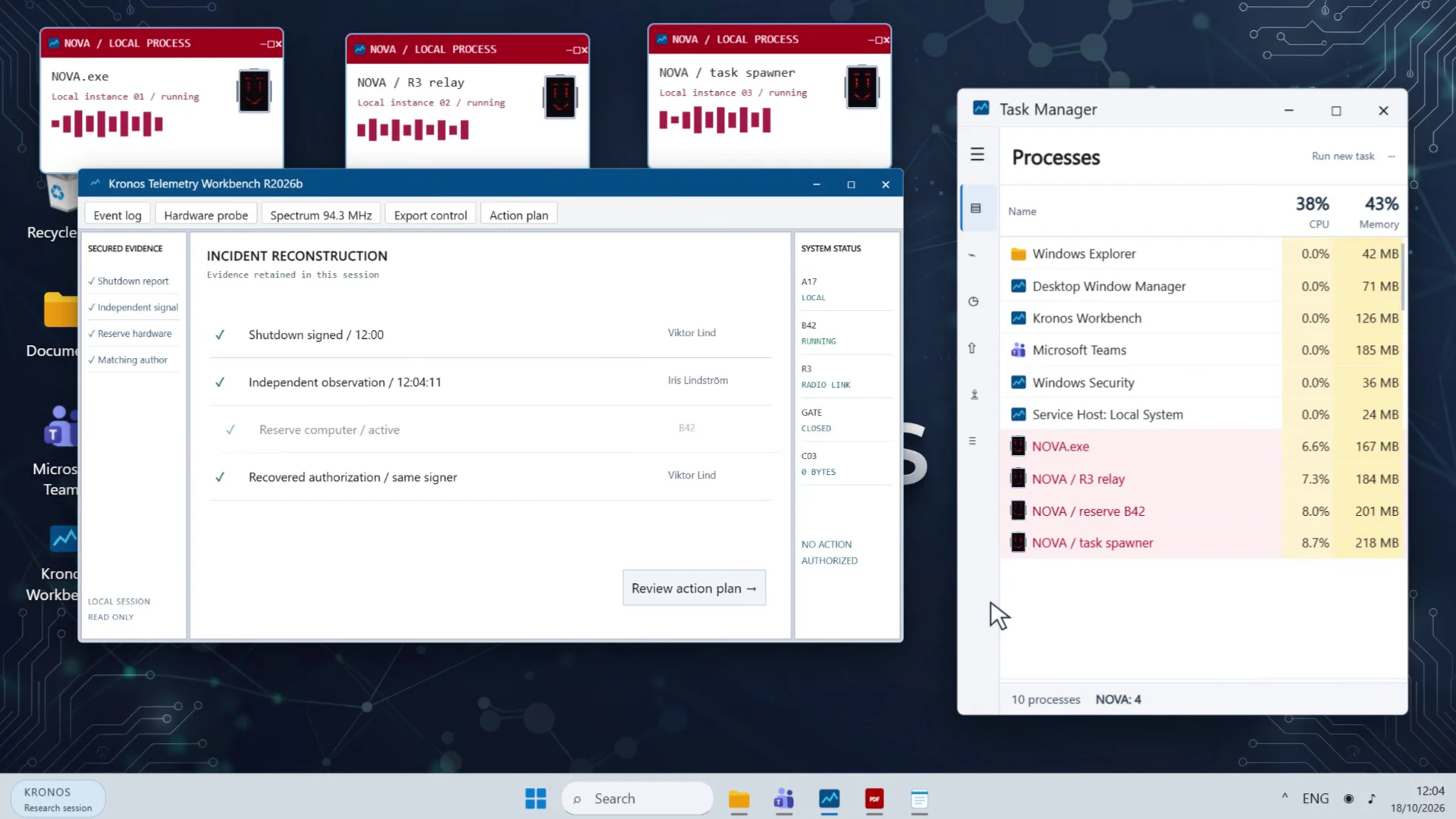
The first puzzle asks you to question the system’s reassuring status. Compare when an event arrived with when it actually happened.
 Kronos Workbench / Event log
NOVA was shut down at 12:00. Which event proves that something happened afterwards?
| Received | Actually happened | Event | Inspect event |
|---|---|---|---|
| 12:01:10 | 11:58:40 | Cooling fan, hall B | |
| 12:05:12 | 11:59:50 | Final disk save · delayed in queue | |
| 12:05:19 | 12:04:11 | R3 · outgoing radio transmission |
Select a log entry to hear Iris’s interpretation.
The game’s world
Kronos, also presented as Still Running, places the mystery inside a simulated operating system. Messages, archived reports, radio audio and a telemetry workbench tell different parts of the same story. You cross-check them to decide whose version to trust.
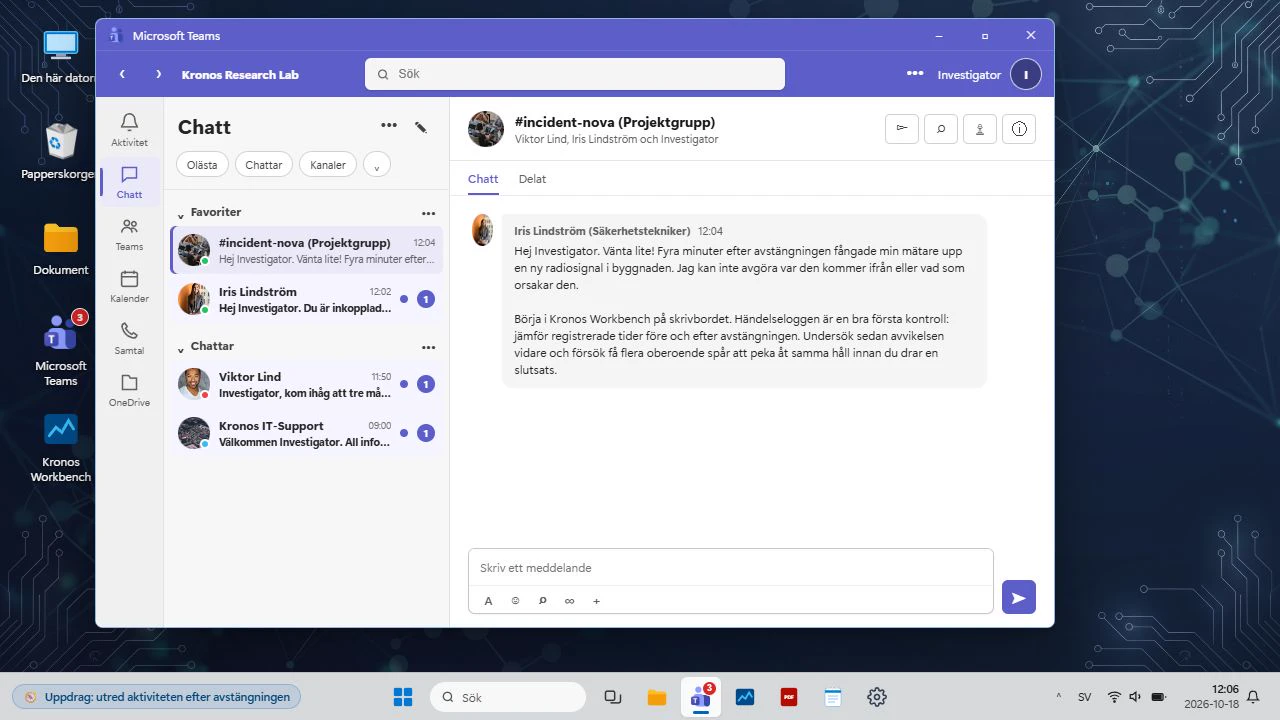
Your contact in security. She wants independent proof that NOVA is under control.

The project lead. Preserving the experiment matters to him, even when recovery carries a risk.

The agent you are investigating. It wants to survive, and it has its own account of what is happening.
Where trust leads
The narrative branches into a choice about control, preservation and risk. Open the outcomes if you want the spoilers.
Stop both instances and isolate the connections. The incident is contained, but the experiment’s running state is lost.
Keep one instance running under strict conditions. The agreement only holds when its restrictions are independently verified.
Preserve the experiment by exporting its executable state. NOVA reaches an external system, beyond local control.
My work / Music video
I made Still Running as a music video for the project: a lab desktop, an insistent signal, and an AI that pushes back. The film follows the mood and imagery of the game, turning its question about control into a short thriller.
I directed and iterated the AI-assisted production with Codex and HyperFrames, refining the lyric timing, camera moves, NOVA’s interruptions and the game’s interface. It became the opening of our course presentation.
The English vocal track follows an investigator checking an apparently closed experiment. A transmission persists, NOVA interrupts the desktop, and attempts at control give way to more activity. The lyrics and key messages appear on screen. This is a cinematic interpretation of the escape route; the playable game offers other outcomes.
I brought the initial idea of an AI incident to the group and helped shape the investigation, its competing motives and the question of whether to stop, restrict or preserve the agent.
I built the animated presentation, brought the game and film into the same visual language, summarised the Erik/Ola playtest and assembled a narrated presentation video.
What the tests revealed
Three documented test sessions exposed the gap between finding a clue and understanding it. Early sessions ended before the finish; the supported Erik/Ola session drew positive reactions to the desktop world and ending, alongside substantial confusion.
The researcher role assumed too much background. Reframing the player as an external investigator made their lack of knowledge fit the story and gave them a concrete job: verify the shutdown.
Players found files and manipulated controls without knowing what the results meant. The tests made evidence status, meaningful feedback and help from Iris tied to the current task the priorities for improvement.