01
All projects
Futuregames · Game design · September 2026
Grannfejden
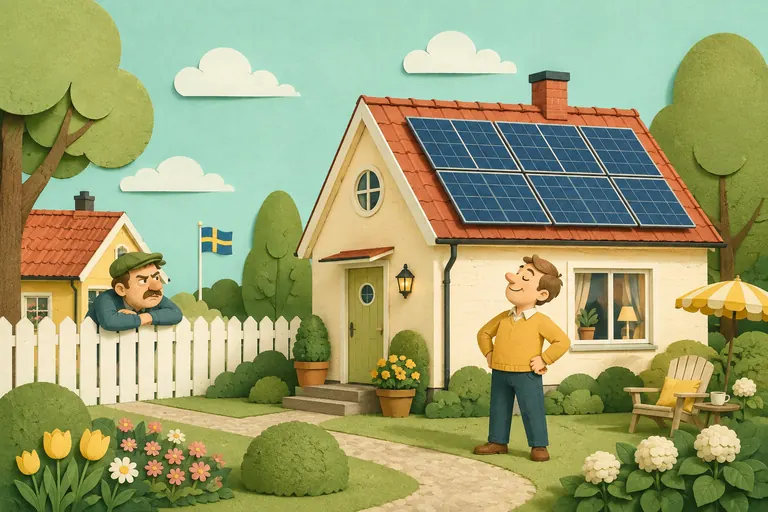
A sunny Swedish neighbourhood. A very petty war.
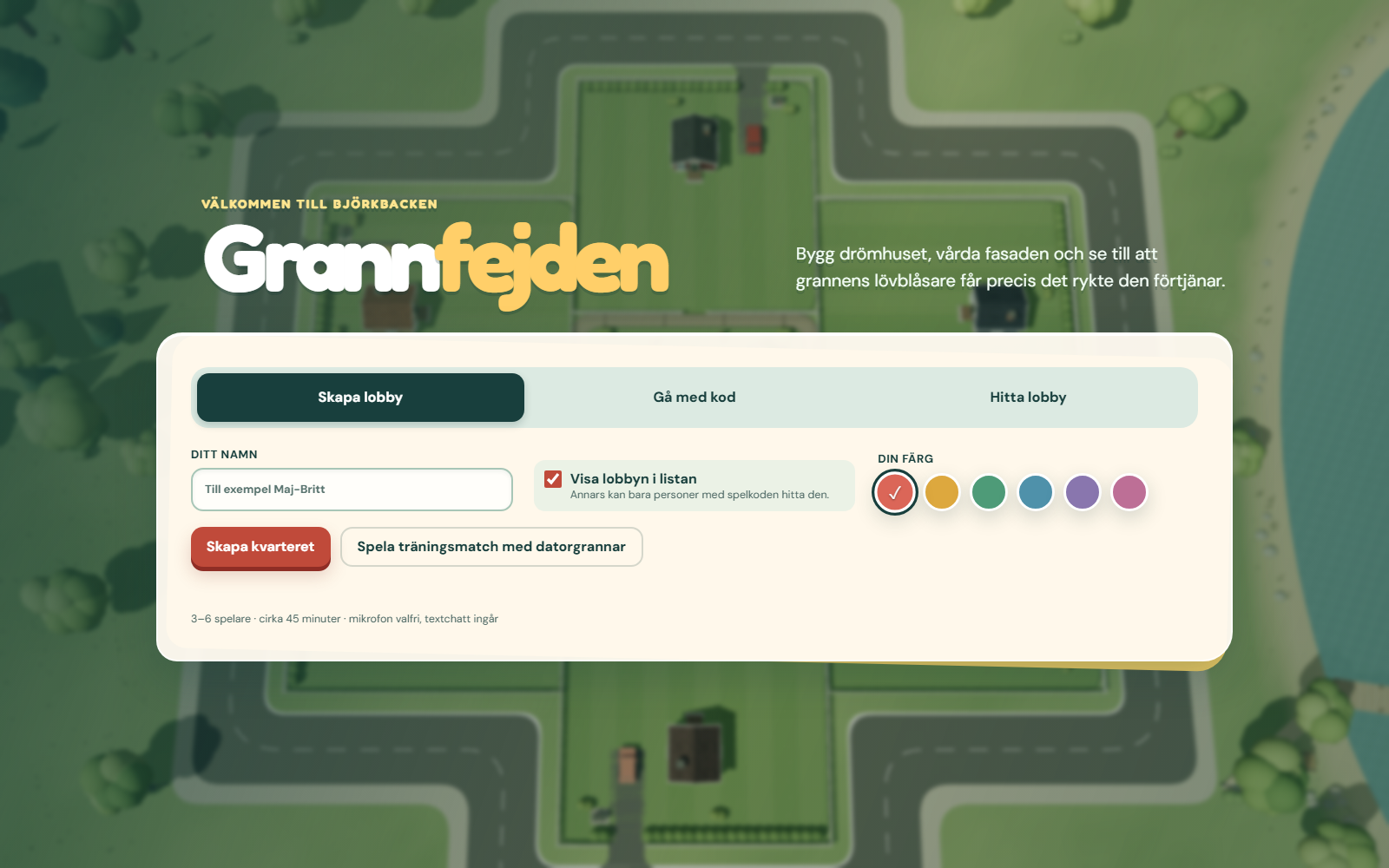
Grannfejden is a social browser board game for 3–6 players about secret plans, garden upgrades, gossip and neighbourhood politics. Everyone plans at once; the consequences become a shared story at the board meeting.
I co-designed the rules with Anna and Pontus, then led the playable browser implementation, systems integration and repeated UX polish from test observations.
- players
- 3–6
- simultaneous rounds
- 10
- playable cards
- 84
- minutes
- 45–60
Well-kept on the surface
Passive-aggressive underneath
The game
Private choices become public neighbourhood drama
The design combines the clarity of a card game with the social tension of a board meeting. Players can grow their property, build reputation or make someone else's afternoon worse—but every advantage creates a trade-off.
02
Plan
Commit two actions in secret while every neighbour is making their own plan.03
Reveal
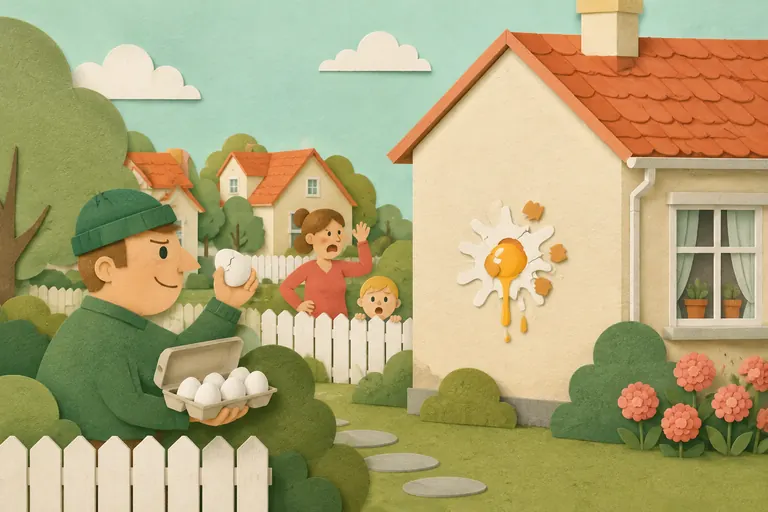
Resolve actions together. Successful sabotage stays anonymous; failure exposes the culprit.04
Debate
Meet with voice or text chat while the chairperson selects two policies for a vote.05
Rebuild
Return to a changed neighbourhood and adapt before the next round begins.Three pressures, no perfect strategy
Makes plans possible
Income funds cards and upgrades, but cash only breaks ties—it cannot win the match by itself.
Builds visible progress
The house and garden grow in the 3D world while property score contributes directly to the result.
Rewards social play
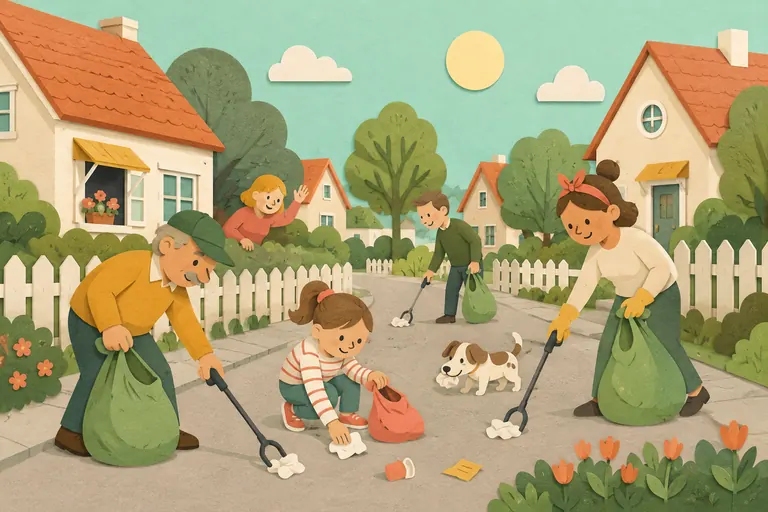
Helping the neighbourhood earns reputation; failed sabotage turns that trust against you.
Final score = Property + Reputation
From whiteboard to browser
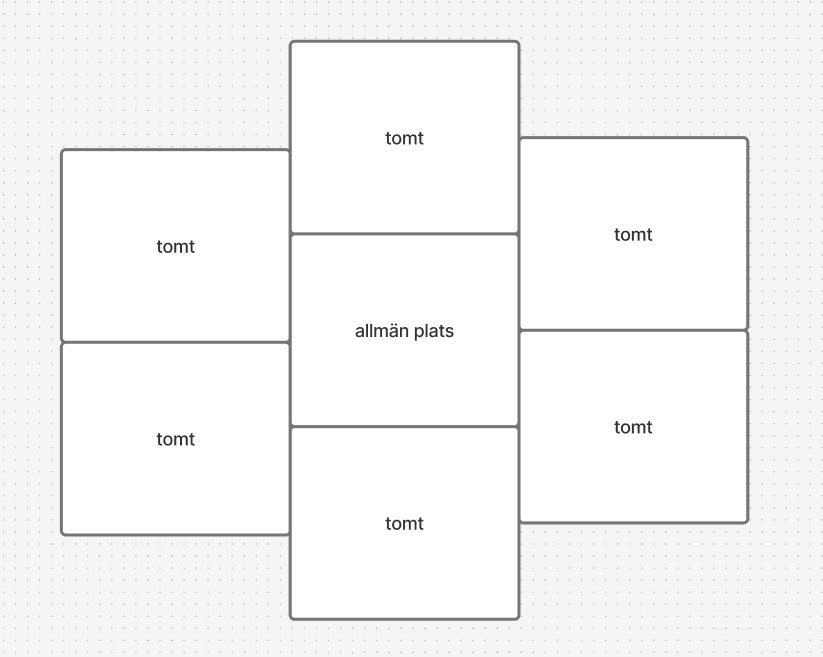
A six-lot sketch became a complete playable neighbourhood
The first drawing only established six homes around a shared space. The useful work was turning that social geometry into rules, a readable 3D world and a multiplayer flow the group could actually evaluate.
03 Sep · first layout
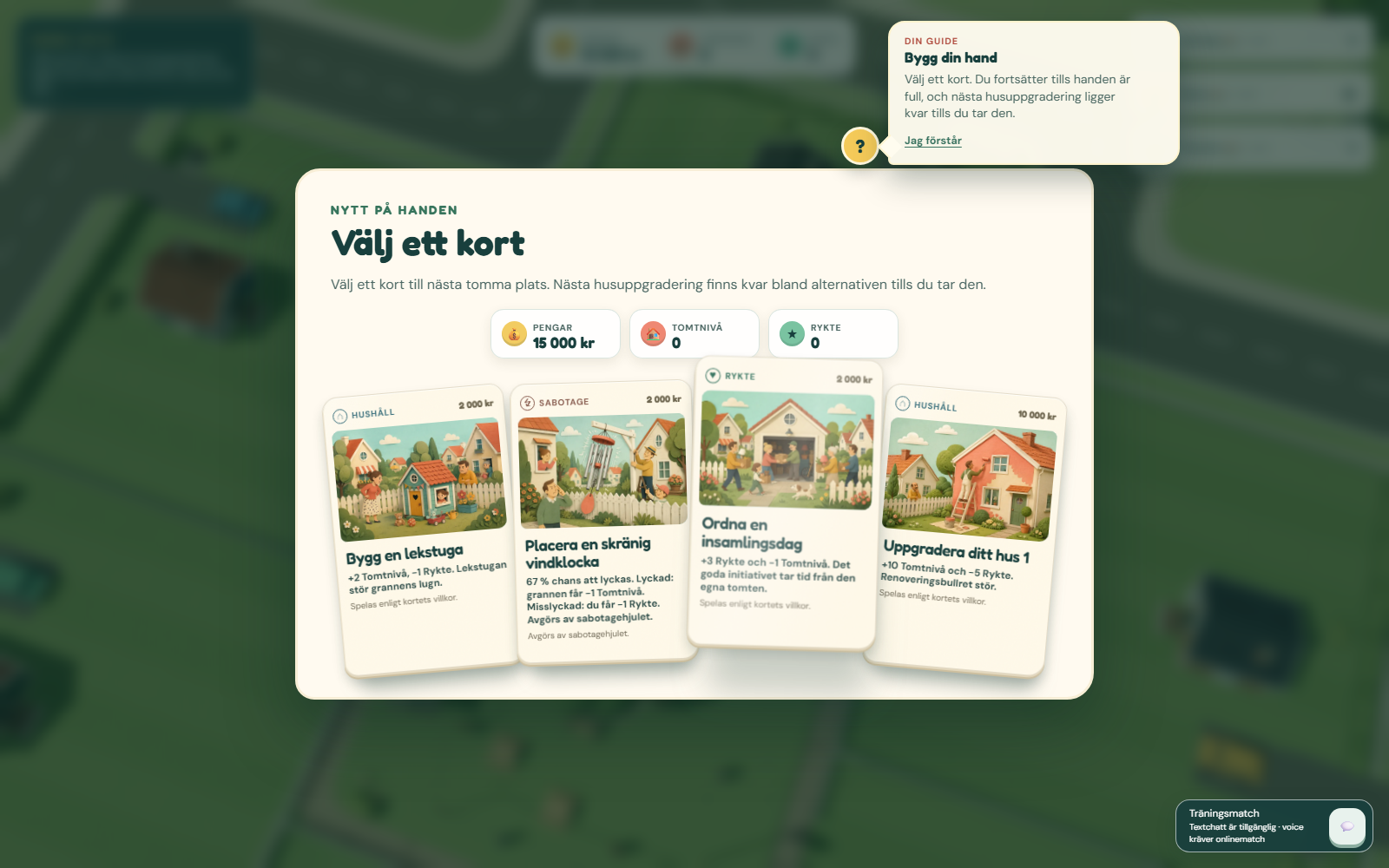
11 Sep · playable build
03 Sep
Find the social engine
We chose resource management, agreements and risk as the mechanical foundation, then anchored them in familiar Swedish neighbour friction.04 Sep
Lock a testable loop
Four-card hands, two simultaneous actions, targeted sabotage and a rotating chairperson gave the concept a finishable round structure.07–08 Sep
Make the idea playable
The prototype gained the Björkbacken 3D world, real-time multiplayer, cards, NPCs, house progression, placement and a dedicated meeting room.09–11 Sep
Turn friction into polish
Playtests drove clearer cards, first-round guidance, better placement, stronger meeting pacing, a sabotage wheel, audio mixing and more reliable chat, voice and reconnection.
What I owned
Game & interaction design
Co-created the concept and rules, translated meetings into testable flows and kept the three resources legible across cards, world and scoring.
Rapid product implementation
Directed and integrated the browser build across TypeScript, Three.js, Supabase Realtime, Postgres, WebRTC and the imported world prototype.
Iteration & delivery
Ran repeated reviews, converted observations into scoped fixes, protected local and online parity and kept the public build deployable as the design changed.
Design through observation
The test showed what players valued—not what the rules claimed
One observed playthrough immediately exposed the real hierarchy: players chased house growth and sabotage, watched whoever was leading and largely ignored reputation. It also revealed terminology, card readability and meeting-state friction that design documents could not show.
Observed behaviour
- Upgraded the house as soon as it became affordable.
- Targeted the current leader rather than following a fixed plan.
- Took several household and sabotage cards but few reputation cards.
- Enjoyed placing objects and seeing the property change.
- Noticed the chairperson's power and wanted to compare who was richest.
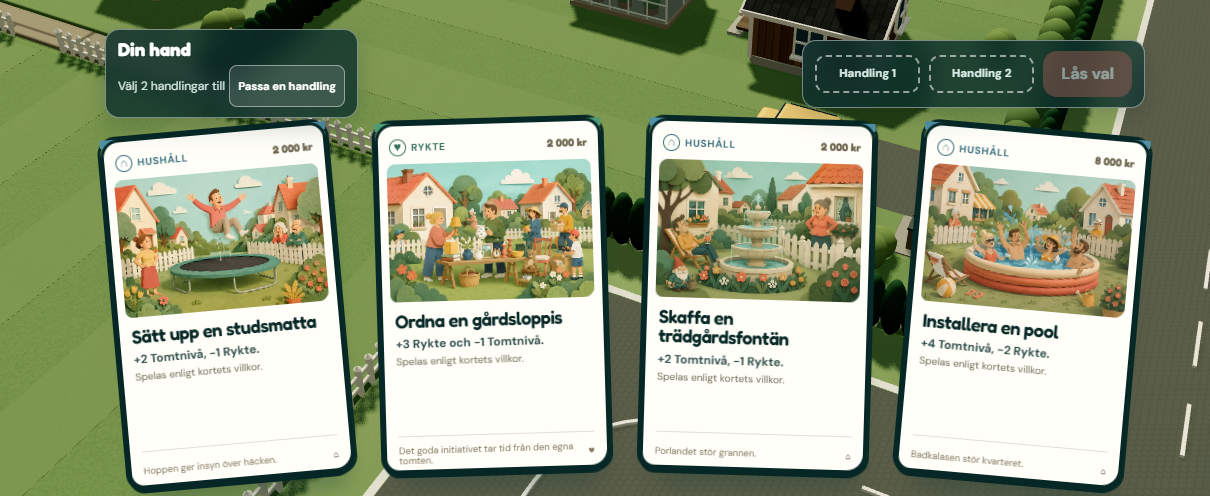
An early interface test made the cards inviting, but titles and effects still depended too much on position and hover.
What changed
Hidden card titlesReadable hands
Titles became visible without hover and cards settled lower on screen with restrained lift instead of dramatic movement.
Rules in footnotesEffects in the description
Costs, percentage chances and consequences moved into compact, direct card copy that matched the sabotage wheel.
Meeting as a menuMeeting as a scene
The camera now moves into a dedicated boardroom where characters, speech, reveals, policy choice and voting share one place.
Tooltips after confusionFirst-round guidance
A short guide now explains drafting, two-action planning and board meetings at the moment each concept first matters.
Under the hedge
A board game with real multiplayer constraints
The playful surface rests on one canonical rules engine. Local practice and online matches use the same decisions, while the server protects private hands, plans and votes until reveal.
One deterministic rules core
The same match seed and commands produce the same result. Practice bots and online players therefore exercise one shared model rather than two versions of the game.
Private until it matters
Supabase Postgres, RLS and Realtime keep hands, targets, plans and votes private. Clients rebuild from canonical snapshots after reconnection.
Conversation has a fallback
Board meetings support optional WebRTC voice, mute/deafen and speaking state, with text chat kept as a complete playable alternative.
The shipped prototype includes
- Shareable six-character lobbies for 3–6 players
- Local practice match with computer neighbours
- 84-card catalogue with household, sabotage and reputation choices
- Five complete house levels and authored object placement
- Neighbourhood events, policies and rotating chairperson
- Animated reveals, sabotage wheel, music and meeting mix
- Responsive UI, keyboard focus and reduced-motion support
- Reconnectable real-time sessions with voice and text chat
Built with
TypeScriptViteThree.jsSupabasePostgresWebRTCVitestPlaywright
Team & outcome
Small team, unusually complete prototype
Grannfejden worked because the group had a concrete object to discuss: rules, cards, a neighbourhood and a match we could play. The implementation moved quickly, but the strongest decisions still came from shared critique and hands-on tests.
Elmer Almer Ershagen
Game design · implementation · integration · UX iteration
Anna
Game design · rules · presentation
Pontus
Game design · rules · playtesting · presentation
What I carry forward
- A strong social reveal can turn several private system changes into one memorable shared story.
- The fastest implementation is only useful when the group can still test and change the underlying rules.
- Visible property growth gave players a stronger emotional anchor than abstract score alone.
- Multiplayer reliability, onboarding and fallback communication are game design—not infrastructure afterthoughts.
Outcome
A public, playable course prototype
The result is a complete ten-round browser game and a strong basis for further validation. Commercial scope remains an open question; the current goal is to learn from real groups rather than imply a finished market release.